
Future Growth Potential of In-Vehicle Networking in Automotive Electronics
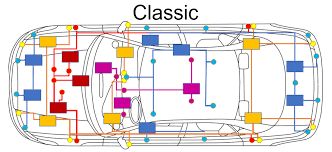
Modern automotive engineering is undergoing a fundamental structural transformation driven by the rapid transition toward software-defined vehicles, centralized compute topologies, and autonomous driving architectures. Historically, electronic control units operated over decentralized, legacy bus protocols like Controller Area Network and Local Interconnect Network, which served basic telemetry and control needs efficiently. However, the modern cockpit and safety systems require real-time transmission of massive data payloads generated by advanced driver assistance sensors, high-definition camera suites, LiDAR systems, and complex infotainment displays. This surge in data bandwidth has pushed legacy networking standards beyond their physical capabilities, compelling automakers to integrate high-speed Ethernet solutions alongside optimized bus architectures. By adopting zonal domain controllers, automotive manufacturers can dramatically streamline wiring harness complexity, decrease total physical vehicle mass, and reduce manufacturing overhead while ensuring deterministic, low-latency communication across essential control nodes.
Transitioning to advanced vehicle communication infrastructure demands rigorous attention to cybersecurity, physical fault tolerance, and deterministic networking standards such as Time-Sensitive Networking. As automobiles become connected endpoints within the broader Internet of Things ecosystem, vehicle network architectures must implement robust hardware security modules, encrypted payload protocols, and isolated virtual networks to safeguard critical drive-by-wire controls against external intrusions. Furthermore, maintaining continuous operational integrity in harsh environmental conditions requires ruggedized automotive-grade cabling and physical transceiver interfaces capable of enduring thermal stress, mechanical vibration, and electromagnetic interference. Beyond physical resilience, system engineers must design deterministic schedules that guarantee safety-critical braking, steering, and powertrain packets receive absolute priority over background infotainment traffic. Through comprehensive In-Vehicle Networking Market analysis, industry leaders evaluate these architectural trade-offs to engineer adaptable, scalable platform architectures that meet the safety requirements of upcoming autonomous driving levels.
How does Ethernet compare to legacy CAN buses in modern vehicles? Ethernet provides drastically higher bandwidth—ranging from 100 Mbps to 10 Gbps and beyond—compared to traditional CAN buses, which typically operate between 250 kbps and 1 Mbps (or up to 5 Mbps for CAN FD). While CAN remains cost-effective and reliable for simple, low-speed microcontroller communication, Ethernet is required for transmitting sensor-dense data like video streams, radar, and software update payloads. Modern architectures use both in a hybrid structure, relying on Ethernet as a high-speed backbone and CAN/LIN for localized, low-speed sensor nodes.
What role does Time-Sensitive Networking (TSN) play in vehicle networks? Time-Sensitive Networking is a suite of IEEE standards that adds deterministic performance to standard Ethernet. In autonomous and software-defined vehicles, critical safety data—such as emergency braking signals—must arrive within precise microsecond windows without packet loss. TSN enforces strict timing, traffic shaping, frame preemption, and clock synchronization across the network, ensuring high-priority control data is delivered reliably even when non-critical infotainment traffic saturates the physical link.
➤➤➤Explore MRFR’s Related Ongoing Coverage In Semiconductor Industry:
Communication Analog Integrated Circuits Market
Compulsory Third Party Insurance Market
Connected Street Lights Market
Cryptocurrency Hardware Wallet Market

 English
 Arabic
 French
 Spanish
 Portuguese
 Deutsch
 Turkish
 Dutch
Dutch
 Italiano
 Russian
 Portuguese (Brazil)
 Greek
Greek
